
About Air Compressor Measurements
If you’ve been researching air compressors, you’ve likely encountered acronyms such as CFM, PSI, and HP. You may even know what they stand for, but what do they mean when it comes to powering tools? D & D Compressor sells and repairs compressors to power a variety of pneumatic tools in every industry, and our experts can break these down to make shopping for a compressor a lot less confusing. Let’s take a look at what’s included on the spec sheet and what it means, so you know you’re picking the right compressor, whether you’re using a nail gun or a jackhammer.
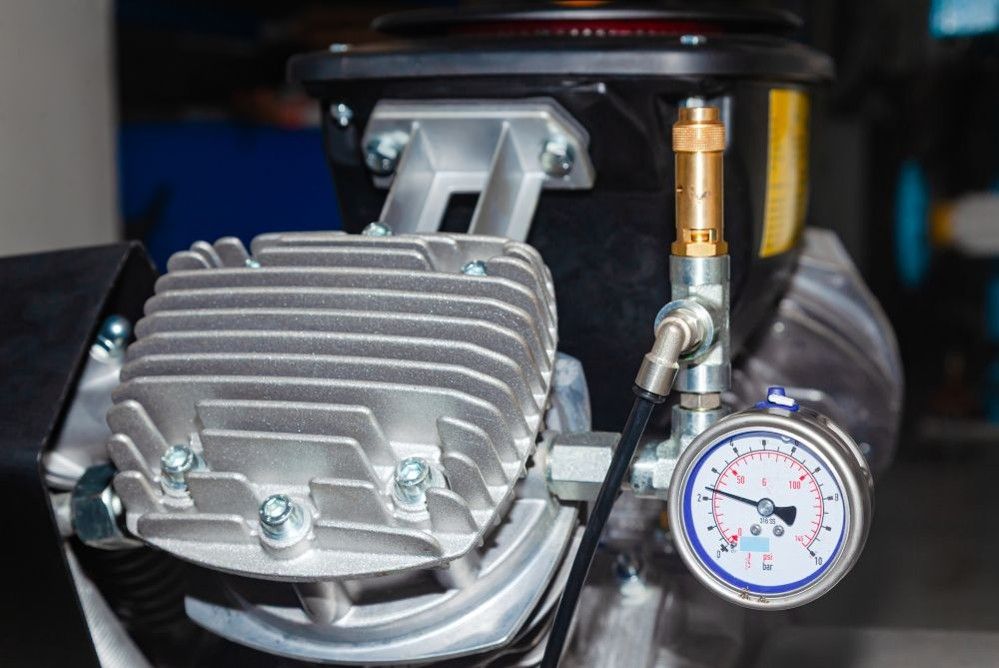
Key Air Compressor Measurements
When evaluating an air compressor, there are four main things to look at: CFM, PSI, horsepower, and tank size. Understanding how these metrics interact is crucial for selecting the right equipment.
CFM (Cubic Feet per Minute)
CFM is arguably the most critical of these four specs. It measures the volume of air the compressor can deliver at a specific pressure level, basically the flow rate. The rate is important because different tools consume air at different rates. Sanders, grinders, and spray guns require higher CFM ratings because they continually draw air. A nail gun or stapler only uses a burst of air for a split second, so they operate at a much lower rating.
Good advice to follow when sizing a compressor is to check the CFM requirement of your most powerful tool and multiply it by 1.5. This buffer ensures you have enough volume to operate the tool efficiently without overworking the compressor pump.
PSI (Pounds per Square Inch)
PSI measures pressure, which is the force behind the air delivery. If CFM is the amount of water flowing through a hose, PSI is how hard that water is spraying out. 90 PSI is the average pressure a pneumatic tool needs to operate. When pressure drops below the tool’s required PSI, something like a nail gun won’t drive a nail flush, or a sander won’t spin fast enough.
It’s worth noting that PSI and CFM are inversely related. As you increase the pressure (PSI), the volume of air delivered (CFM) usually drops. That’s why you’ll often see specs listed as “X CFM @ 90 PSI.” This tells you exactly how much volume you get at that specific working pressure.
In scientific applications or vacuum systems, a PSIA unit may also be discussed. PSIA stands for pounds per square inch absolute and includes atmospheric pressure in its reading, which is 14.7 PSI at sea level. This is a more technical aspect, and in most tool applications, a pounds per square inch gauge (PSIG) is usually sufficient.
Horsepower (HP)
HP measures the power of the motor that drives the compressor pump. In the past, manufacturers used HP as the primary selling point, but it can be misleading. A higher horsepower rating generally means the motor can spin the pump faster or drive a larger pump, which theoretically fills the tank more quickly.
However, HP alone doesn’t tell you how well the compressor delivers air. An inefficient motor with high horsepower might produce less air than a more efficient, lower-HP motor. For most applications, it’s smarter to prioritize CFM and PSI ratings over horsepower. Use HP as a secondary indicator of the motor’s strength, specifically regarding how fast it can recover (refill the tank) after the pressure drops.
Tank Size
Tanks are measured in gallons and represent the storage capacity of the compressed air. The larger the tank, the more it holds, meaning you can use your tools for longer periods before the motor needs to kick on to repressurize the system. If you’re using tools that require a high continuous volume, such as a sandblaster, a large tank helps maintain consistent pressure and prevents the motor from running nonstop, which can lead to overheating. Smaller tanks, typically two to six gallons, are usually sufficient for intermittent tasks such as framing or finish carpentry. They’re also easily portable.
Matching Measurements to Applications
Once you understand the metrics, the next step is applying them to what you’ll be using the compressor for. The requirements for a hobbyist in a garage are a lot different from those of a professional auto body shop. Let’s look at consumption estimates of common tools to illustrate this point:
- Intermittent Tools – Brad nailers, finish nailers, and grease guns typically require 0.5 to 2 CFM at 90 PSI. A portable unit with a small tank is usually perfect for these tasks.
- Medium-Duty Tools – Impact wrenches, ratchets, and drills often require between 4 and 6 CFM. You’ll need a mid-sized compressor, typically with a 20- to 30-gallon tank, to keep up with the work without frequent pauses.
- Continuous Use Tools – Sanders, grinders, and paint sprayers are air-hungry, often requiring 8 to 15 CFM or more. A heavy-duty, stationary compressor with a large tank (60 gallons or more) and a high-efficiency pump is standard.
Industrial vs. DIY Needs
For DIY enthusiasts or a compressor for a home garage, a pancake or hot dog style compressor with minimal HP and a small tank usually suffices for tasks like inflating tires and light nailing. Industrial applications often require two-stage compressors or advanced equipment, such as rotary screw air compressors. Two-stage models compress air twice to achieve higher PSI and greater efficiency, making them suitable for manufacturing floors or automotive shops where multiple lines are running simultaneously. Rotary screw compressors can operate continuously, 24 hours a day, 365 days a year, without requiring a cool-down period.
Shop Air Compressors Confidently
Selecting the right air compressor is a balance between understanding volume (CFM), pressure (PSI), power (HP), and storage capacity (tank size). By focusing on these key measurements and matching them to your tools and tasks, you can invest in a machine from a trusted retailer like D & D Compressor, Inc. knowing it can handle the type of work your do.